IV Service Line
International Trade Services.
Where freight crosses lines on a map.
- Freight forwarding
- Customs brokerage
- Cross-border & Latin America
- Supply chain consulting
Operations
Where freight crosses lines on a map.
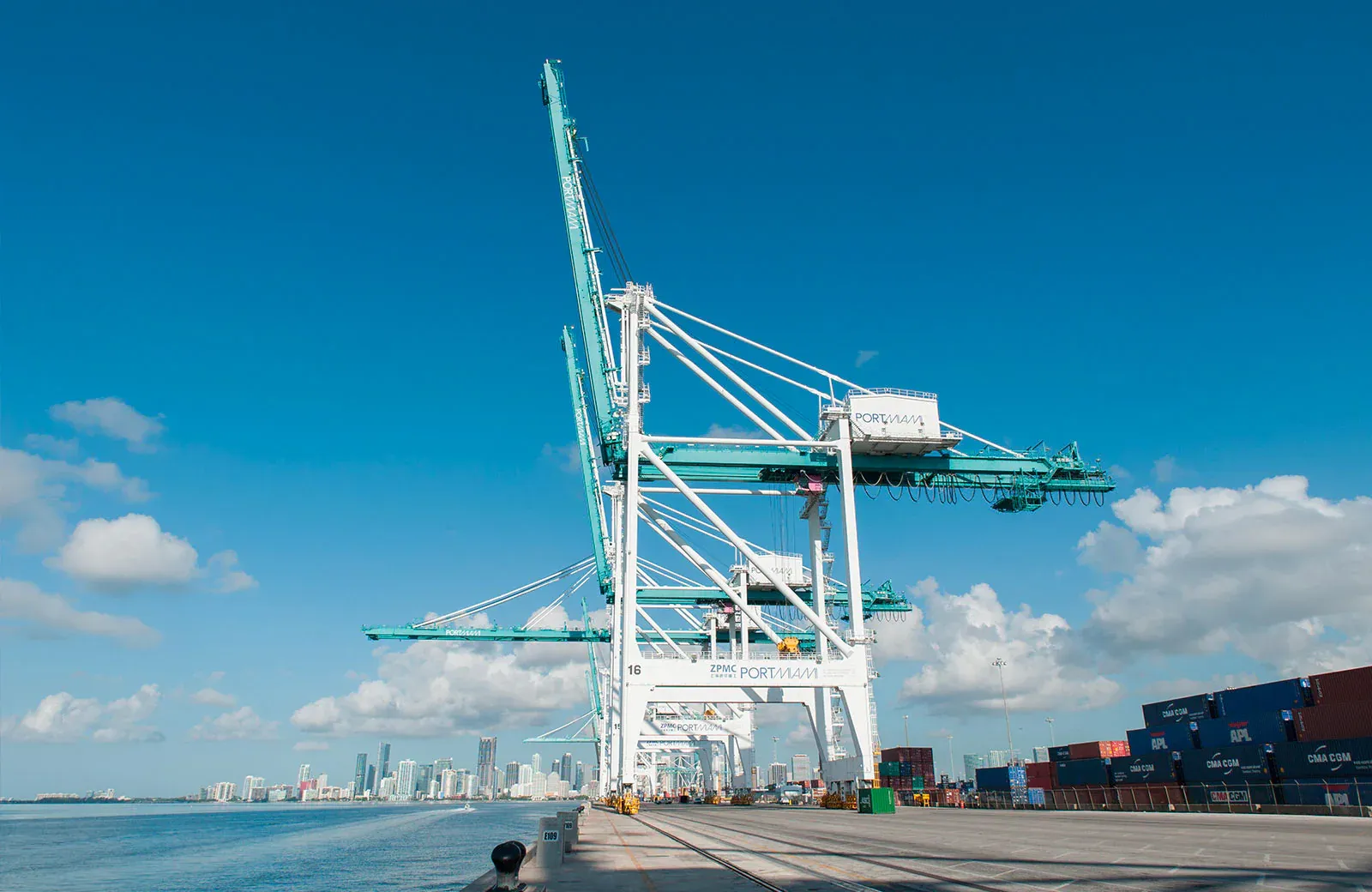
International Trade is the line that runs underneath every other line on this site. A container off PortMiami arrives with a customs entry; a perishable shipment at MIA needs a CBP release before it leaves the cargo apron; an outbound truckload to a Caribbean basin retailer needs a commercial invoice, a packing list, and an export declaration. The paperwork is the work, and we run it with documentation discipline as the baseline.
Our density is on Latin America trade lanes. South Florida is the dominant U.S. gateway to the hemisphere — PortMiami and Port Everglades concentrate Caribbean-basin container flows, MIA is the country’s #1 air gateway to Latin America by a wider margin than any other comparison in U.S. logistics. Bilingual (English / Spanish) trade documentation is standard. Most LATAM customs interactions run on Spanish-language paperwork at one stage; the workflow runs in both languages by default.
Customs brokerage runs through licensed broker partners. We coordinate, prepare, and review entries; the licensed broker files. That separation of duties is deliberate — the broker carries the regulatory authority, we carry the operational context. Together, that is what gets entries cleared cleanly the first time and rebilled cleanly when something needs fixing.

The line
What’s included in the line.
- Freight forwarding. Ocean and air, inbound and outbound. Booking with the ocean carriers and freighter airlines that call PortMiami, Port Everglades, and MIA; documentation preparation; freight tracking through to U.S. destination or onward export. NVOCC-equivalent workflow when the client needs consolidated container service.
- Customs brokerage. Coordinated through licensed broker partners. Entry preparation, HTS classification review, ACE filing oversight, duty payment workflow, exception handling. Bilingual documentation for LATAM shipments. FTZ entry routing through FTZ #281 and FTZ #25 where the workflow benefits.
- Cross-border & Latin America. Specialized workflows for the Caribbean basin, Mexico, Central America, and South American trade lanes. CBP duty optimization through FTAs (USMCA, CAFTA-DR, the Caribbean Basin Initiative). Coordinated with carriers, brokers, and consolidators along the specific lane.
- Supply chain consulting. Clients building or revising their Latin America trade architecture — should the warehouse sit in Miami or in-country? Which port, which airport, which carrier base? Where does FTZ routing pay off, where doesn’t it? We work the question end to end and hand back an architecture that fits the freight.
Industries
Who we work with on the paper layer.
- Latin America-facing importers. U.S. brands sourcing from Colombia, Ecuador, Brazil, Chile, Costa Rica, Mexico, Guatemala, Honduras, the Caribbean basin. Perishables, consumer goods, industrial inputs, raw materials.
- Latin America-facing exporters. U.S. brands shipping into LATAM consumer markets, distributor networks, or industrial customers. Higher-paperwork lanes, higher documentation discipline required.
- Pharmaceutical importers. Coordinated with the CEIV-certified pharma handlers at MIA and the customs broker network that handles regulated medications routinely.
- FTZ tenants. Clients running freight through FTZ #281 (PortMiami / MIA) or FTZ #25 (Port Everglades) for duty deferral, re-export elimination, or assembly-inside-zone workflows.
- Cruise hospitality supply chain. International provisions and parts for cruise vessels, where customs entries run on accelerated schedules and the carrier base is highly specific.
- Cross-border e-commerce. Operators shipping consumer parcels south or routing inventory through a U.S. staging point for onward LATAM delivery.
Our posture
How we work the paper layer.
The paper layer is where freight clears or doesn’t. Customs entries that don’t match the freight, commercial invoices that don’t reconcile, packing lists that diverge from the declaration — these are the things that hold a container at the dock and cost the client money. Our discipline is to catch them before the entry is filed, not after.
Isabella Reyes is the operations lead on this line and the author of our journal’s Latin America trade coverage. Thirteen years working the South Florida corridor, fluent in English and Spanish, with a working understanding of the documentation requirements for every major LATAM trade lane that touches the corridor. That’s the kind of institutional knowledge that doesn’t surface in a software interface.
Next
If your freight crosses a border.
Tell us the origin, the destination, the freight, and the lane. We’ll route the inquiry to the broker, the carrier, and the consolidator who handle that line cleanly.