I Cargo Gateway
PortMiami.
Florida’s biggest container box, the world’s busiest cruise port, and the only post-Panamax channel south of Norfolk.
- Annual volume
- 1,115,058 TEUs (FY2025)
- National ranking
- #11 busiest U.S. container port (FY2025)
- Distance from anchor
- 40 min south
- Foreign Trade Zone
- FTZ #281
Operations
Dodge Island, deep water.
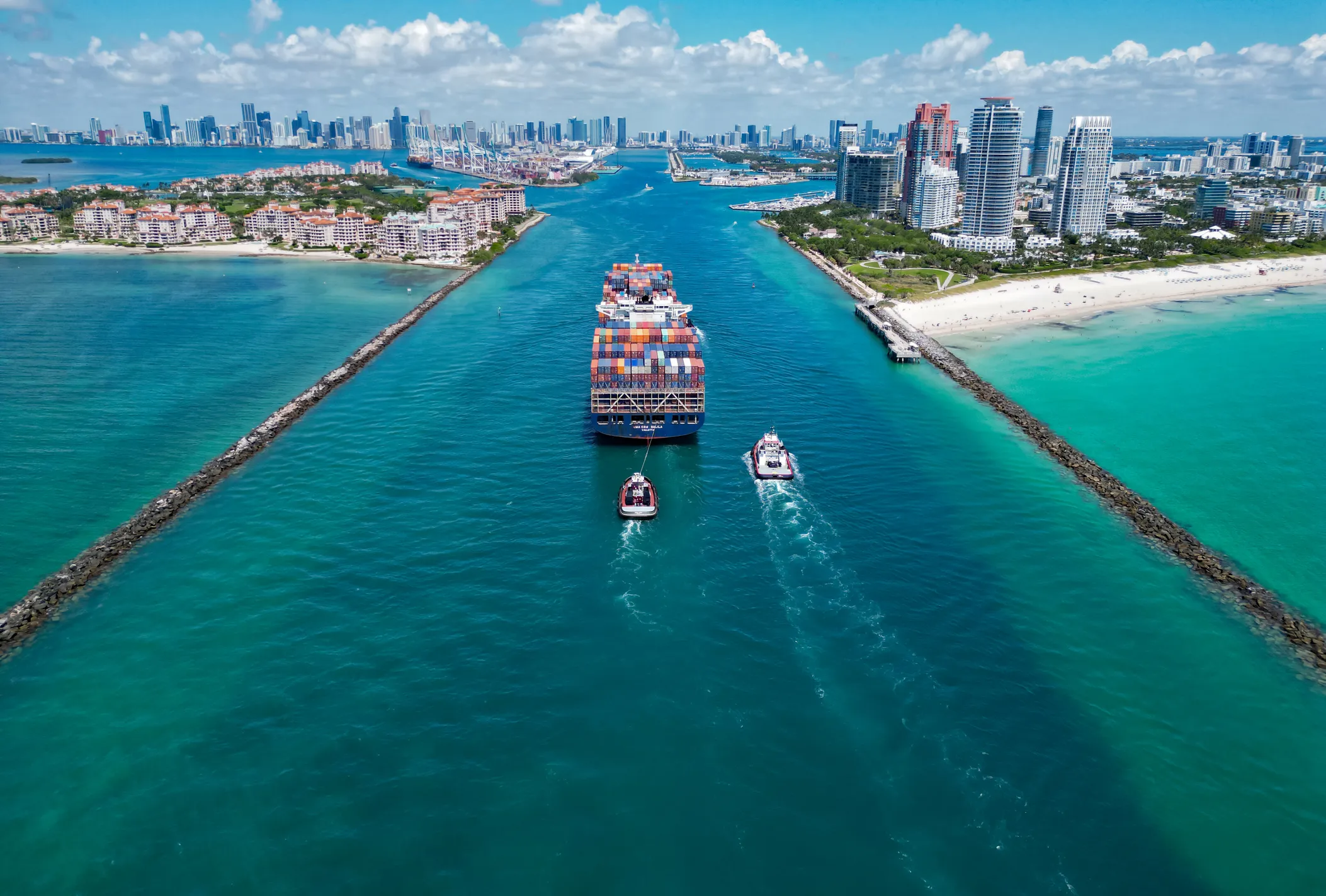
PortMiami occupies the entirety of Dodge Island in Biscayne Bay, just east of downtown Miami — forty minutes south of Pompano Beach by truck. The footprint covers roughly 520 acres of operational area: three container terminals, a major cruise complex, and dedicated cargo infrastructure that has been almost entirely rebuilt over the past fifteen years.
In 2014, the $1 billion PortMiami Tunnel opened — a toll-free dedicated truck route running beneath Government Cut from Watson Island, connecting the port directly to I-395 and the federal interstate system without sending a single container through the downtown street grid. In 2015, the Deep Dredge project deepened the channel to 50–52 feet, making PortMiami one of the first ports south of Norfolk capable of handling fully-loaded post-Panamax container ships. The Florida East Coast Railway operates an on-dock intermodal yard inside the port footprint — one of the few U.S. ports where a container can move from ship to inland rail without leaving the terminal gate.

Three terminal operators handle the cargo as a landlord- port arrangement:
- South Florida Container Terminal (SFCT) — the largest operator on the port. Eighteen electric rubber-tired gantry cranes (eRTGs) after the 2025 phase-two expansion, enabling higher container stacks and tighter yard rotations.
- POMTOC (Port of Miami Terminal Operating Company) — the only non-carrier-owned operator at PortMiami, in continuous operation since 1994.
- Seaboard Marine — direct regular service between North America, the Caribbean Basin, Central America, and South America.
Thirteen shipping lines call PortMiami regularly. All five of the world's largest international container carriers — CMA CGM, COSCO, Hapag-Lloyd, Maersk, and MSC — use the port as a regular port of call. Combined annual throughput in FY2025: 1,115,058 TEUs, an eleventh consecutive year exceeding one million.
Cargo
What's in the box.
Containerized cargo dominates PortMiami's throughput, but the trade flow is unusually geographic. FY2025 cargo by region:
- Latin America & Caribbean
- 48%
- Asia
- 31%
- Europe
- 20%
That mix is materially different from any other U.S. East Coast container port — most are dominated by Trans-Atlantic and Trans-Pacific flows. PortMiami's largest single segment is intra-hemisphere Latin American trade, a function of geography that no Mid-Atlantic or Gulf port can match.
Within containerized cargo, three sub-categories deserve note:
- Perishables. PortMiami markets a "perishables express lane" for refrigerated containers carrying cut flowers from Colombia and Ecuador, seafood from Chile and Mexico, fresh produce from across Central America. Cold-chain integrity is a daily operational requirement at this port, not a specialty workflow.
- Project cargo and breakbulk. Heavy equipment, oversize industrial components, modular construction units bound for Caribbean basin infrastructure projects and Latin American energy / mining operations.
- Consumer goods. Apparel, electronics, household items moving inbound from Asia for distribution across the Southeastern U.S., and outbound to Latin American consumer markets.
Industries
Who's on the manifest.
The shipper base at PortMiami spans every industry that touches Latin American trade or Southeastern consumer distribution. A handful dominate by volume:
- E-commerce and consumer goods distribution. Asian-origin inbound containers staged at PortMiami and distributed across Florida and the broader Southeast.
- Cruise line supply chain. Provisions, parts, and consumables for the dozens of cruise vessels home-ported at PortMiami — the world's busiest cruise port.
- Construction materials. Italian and Spanish tiles, marble, stone fixtures, finished architectural materials — the volume that anchors PortMiami's European trade share.
- Pharmaceutical cold chain. Temperature-controlled medications, frequently in concert with MIA's air-cargo cold chain network for last-leg distribution.
- Automotive parts. Inbound for dealer-network distribution across the Southeast; outbound for Latin American export.
- Apparel and textiles. High-volume Asia-origin imports moving through PortMiami's Trans-Pacific call windows.
Our posture
How we operate at PortMiami.
Forty minutes north of PortMiami sits Pompano Beach. We work the drayage corridor between the two daily — containers off the dock, onto a chassis, into our warehouse network or directly to the customer's dock door, depending on the lane and the freight.
We don't run the terminals. The three operators at PortMiami have been doing that work since the early '90s, and we don't pretend to compete with that institutional knowledge. What we do is sit close enough to the gate to know the chassis pool by sight, the routing exceptions by name, and the customs brokers who'll rebill an entry at midnight when a manifest needs fixing. That's the operating posture — proximity, relationships, and the discipline to use both.
For freight clearing PortMiami: drayage to our Pompano Beach warehouse, transload onto LTL or FTL for inland delivery, customs entry coordination, and Foreign Trade Zone routing through FTZ #281 where the workflow benefits. For freight bound the other direction — exports through PortMiami — we handle the freight forwarding and customs preparation, then hand off to the carrier or NVOCC for the ocean leg.
Next
If your freight has to clear PortMiami.
Tell us the lane and the freight — we'll route the inquiry to the operator who knows the right terminal for it. Somebody picks up the phone within thirty minutes during business windows.