II Cargo Gateway
Port Everglades.
The corridor’s tri-port — containers fifteen minutes south, petroleum into the South Florida grid, and the I-595 connector straight onto the inland network.
- Annual volume
- 1,167,552 TEUs (FY2025 record)
- National ranking
- #15 busiest U.S. container port (FY2025)
- Distance from anchor
- 15 min south
- Foreign Trade Zone
- FTZ #25 · $9B (CY2024)
Operations
Three working zones, fifteen minutes south.
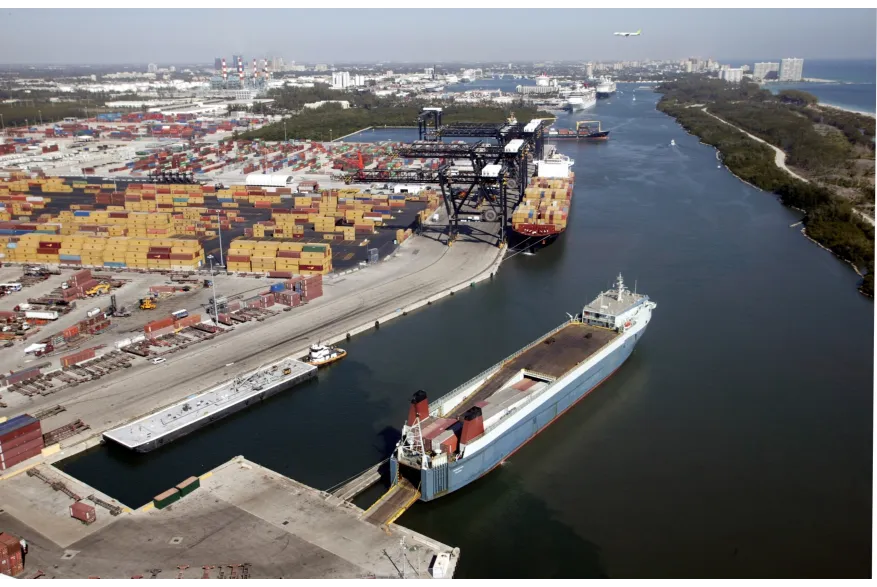
Port Everglades sits in Fort Lauderdale, fifteen minutes south of Pompano Beach — the closer of the two seaports inside the corridor and the closest deep-water container port to the anchor. It is also a genuine tri-port: containerized cargo, cruise homeporting, and one of the largest petroleum receiving operations on the U.S. East Coast all coexist inside the same harbor footprint.
FY2025 closed at 1,167,552 TEUs — an all-time record, with Q1 alone running 12% ahead of the prior-year first quarter. By container volume Port Everglades ranks #15 in the U.S. and trades places with PortMiami year-over-year for #1 in Florida. Twenty shipping lines call regularly across ten terminal operators — a more fragmented operator base than PortMiami, but the depth and specialization of those operators is part of what makes the port competitive.
The Florida East Coast Railway operates a 43-acre near-dock Intermodal Container Transfer Facility (ICTF) alongside the cargo terminals — containers move from ship to chassis to inland rail without the truck legs other ports require. Two active infrastructure programs are reshaping capacity: the Southport Turning Notch Extension (additional berthing and yard depth) and Slip 1 (a separate yard development).
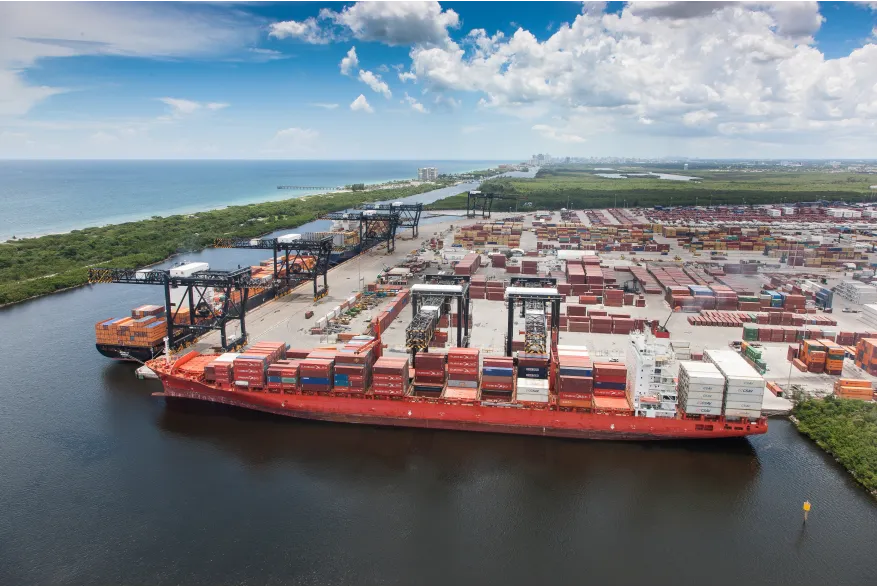
Ten terminal operators serve Port Everglades. Most are tightly coupled to specific shipping lines:
- Florida International Terminal (FIT) — CMA-CGM, Hapag Lloyd, Maersk, ONE, Great White Fleet
- Port Everglades Terminal (PET) — MSC, ZIM, ServiPort
- Crowley Liner Services — Crowley
- Sun Terminals — King Ocean Services
- Hyde Shipping — Hybur
- Rehoboth Terminal — Accordia, Hoegh Autoliners
- Pangaea Port Everglades — Balearia Caribbean, Red Line
- SOL — AGRIEX, Fyffes (perishables / bananas)
- Hirsch Stevedoring / Hirsch Maritime — multi-carrier
- Logistec — Mailboat Co.
The fragmentation is operationally significant. A shipper choosing a Port Everglades call doesn't just choose a carrier — they inherit a terminal operator, a chassis pool, and a yard layout. Knowing which operator is best suited for which lane and which freight type is one of the things miamidade3pl does as a matter of course.
Cargo
What moves through Port Everglades.
Port Everglades runs four distinct cargo layers inside the same harbor. Each operates on its own dock infrastructure, its own terminal operator chain, and its own customer base.
- Containerized cargo. 1,167,552 TEUs in FY2025. The bulk of the freight throughput. Caribbean and Central American trade lanes dominate (Crowley, King Ocean, Hybur, Seaboard), with the major Trans-Atlantic and Trans-Pacific globals (CMA-CGM, MSC, ZIM, Maersk, Hapag Lloyd) layered on top.
- Perishables. Port Everglades is a major U.S. entry point for Caribbean and Central American produce — bananas, melons, pineapples, citrus. Fyffes and AGRIEX move banana volume through SOL's terminal. Refrigerated containers and chilled break-bulk infrastructure run alongside.
- Bulk and break-bulk. Heavy equipment, project cargo, vehicles (Hoegh Autoliners through Rehoboth), construction modules, oversize industrial freight. Florida's east-coast entry point for ro-ro and break-bulk that doesn't fit a box.
- Petroleum and energy. One of the largest petroleum receiving operations on the U.S. East Coast. Approximately one-third of all petroleum consumed in Florida is stored and distributed by companies operating at Port Everglades — gasoline, jet fuel, and increasingly LNG. This is the working backbone of South Florida's energy supply.
Industries
Who's at the gate.
Port Everglades' four cargo layers mean the shipper base is broader than a pure container port's. Industries that move significant freight through the port include:
- Grocery, retail, and food service. Caribbean and Central American produce — bananas (Fyffes), melons, pineapples, citrus — landing inbound at Port Everglades for distribution across Florida and the Southeast.
- Energy and fuel distribution. Petroleum companies operating from Port Everglades supply roughly a third of Florida's gasoline, jet fuel, and related products. The port is functionally critical to the region's energy grid.
- Construction and industrial. Heavy machinery, construction modules, project cargo for Florida infrastructure projects and Caribbean basin development.
- Automotive. Hoegh Autoliners moves vehicle inventory through Rehoboth Terminal — primarily inbound for Florida and Southeastern dealer networks, outbound for Caribbean and Latin American markets.
- Cruise hospitality supply chain. Port Everglades is one of the busiest cruise homeports in the world; provisions, fuel, and consumables for those vessels run alongside the container traffic.
- E-commerce and consumer goods. Inbound Asian and European consumer goods staged for Southeast U.S. distribution, frequently in conjunction with PortMiami when volume permits split routing.
Our posture
How we operate at Port Everglades.
Fifteen minutes north of Port Everglades sits Pompano Beach. We drayage this corridor more than any other — short legs, predictable windows, the most operationally efficient seaport relationship in the network.
The fragmentation across ten terminal operators is a feature, not a bug — but it requires institutional knowledge to navigate. Each operator has its own gate hours, its own chassis pool, its own turnaround characteristics. Routing a freight forwarding inquiry to the right terminal-shipping line pairing on day one is the difference between a same-day pickup and a two-day delay. That's the kind of detail that doesn't surface in a brochure.
For freight clearing Port Everglades: drayage to our Pompano Beach warehouse (often inside 25 minutes door-to-door including gate time), transload onto LTL or FTL for inland delivery, customs entry coordination, and Foreign Trade Zone routing through FTZ #25 — Florida's first and largest, with roughly $9 billion in goods moving through it in CY2024. Perishable freight, given Port Everglades' volume in that category, is a workflow we run with particular discipline.
For exports through Port Everglades — Caribbean, Central American, South American trade lanes especially — we handle freight forwarding, customs preparation, and the handoff to the chosen carrier or NVOCC for the ocean leg.
Next
If your freight has to clear Port Everglades.
Tell us the lane and the freight — we'll route the inquiry to the terminal operator and shipping line that fits the load. Somebody picks up the phone within thirty minutes during business windows.