III Cargo Gateway
Miami International Airport.
The country’s #1 air freight gateway by total tonnage — and the dominant U.S. connection to Latin America by a wider margin than any other comparison in American logistics.
- Annual volume
- 3.4 million tons (2025) — +13.2% YoY
- National ranking
- #1 U.S. airport for international freight, #3 for total freight (2025)
- Distance from anchor
- 40 min south
- Foreign Trade Zone
- FTZ #281 · Magnet Site
Operations
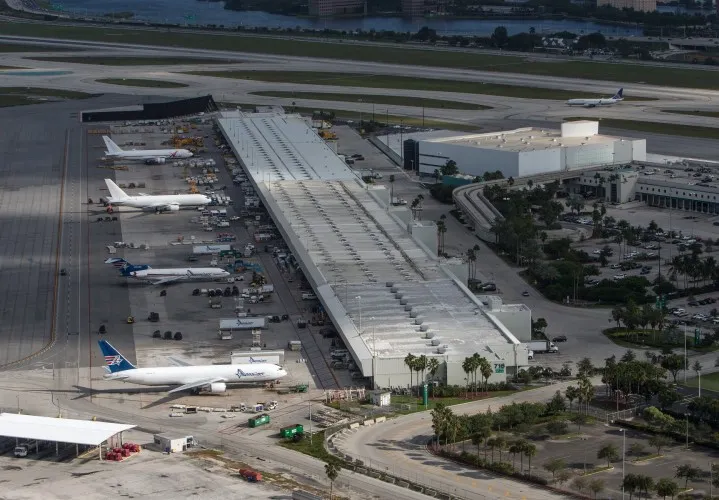
The apron west of the terminals.
Miami International Airport's cargo operations sit on the apron west of the passenger terminals — a distinct geography that most travelers never see. Forty minutes south of Pompano Beach by truck, MIA brands itself the Gateway of the Americas, and the numbers back the framing: in CY2025, the airport handled a record 3.4 million tons of airfreight, a 13.2% increase over 2024 and a sixth consecutive year of cargo growth.
MIA is America's #1 airport for international air freight and #3 for total freight. The 2025 cargo trade value reached $89 billion (origin & destination only) — up 8.2% year over year. The international/domestic split is 85%/15%; in 2025, for the first time in over a decade, in-transit freight surpassed origin-destination freight, settling at a 55%/45% mix. That single inversion is the clearest statistical signal of MIA's evolution from a regional gateway into a true hub-of-hubs.
More than 35 all-cargo carriers operate scheduled or charter freighter service from MIA. The roster includes U.S. domestic majors (FedEx, UPS, Atlas Air, Amerijet, Polar Air), European carriers (Cargolux, KLM/Martinair, Lufthansa Cargo, Turkish Airlines), Latin American specialists (LATAM Cargo Chile, LATAM Cargo Colombia, Avianca Cargo/Tampa Cargo, Aeronaves TSM, MASair), Asia-bound capacity (Cathay Pacific, China Airlines, Korean Air, Qatar Airways Cargo, Emirates), and dedicated integrators (DHL Aviation/Aeroexpreso).
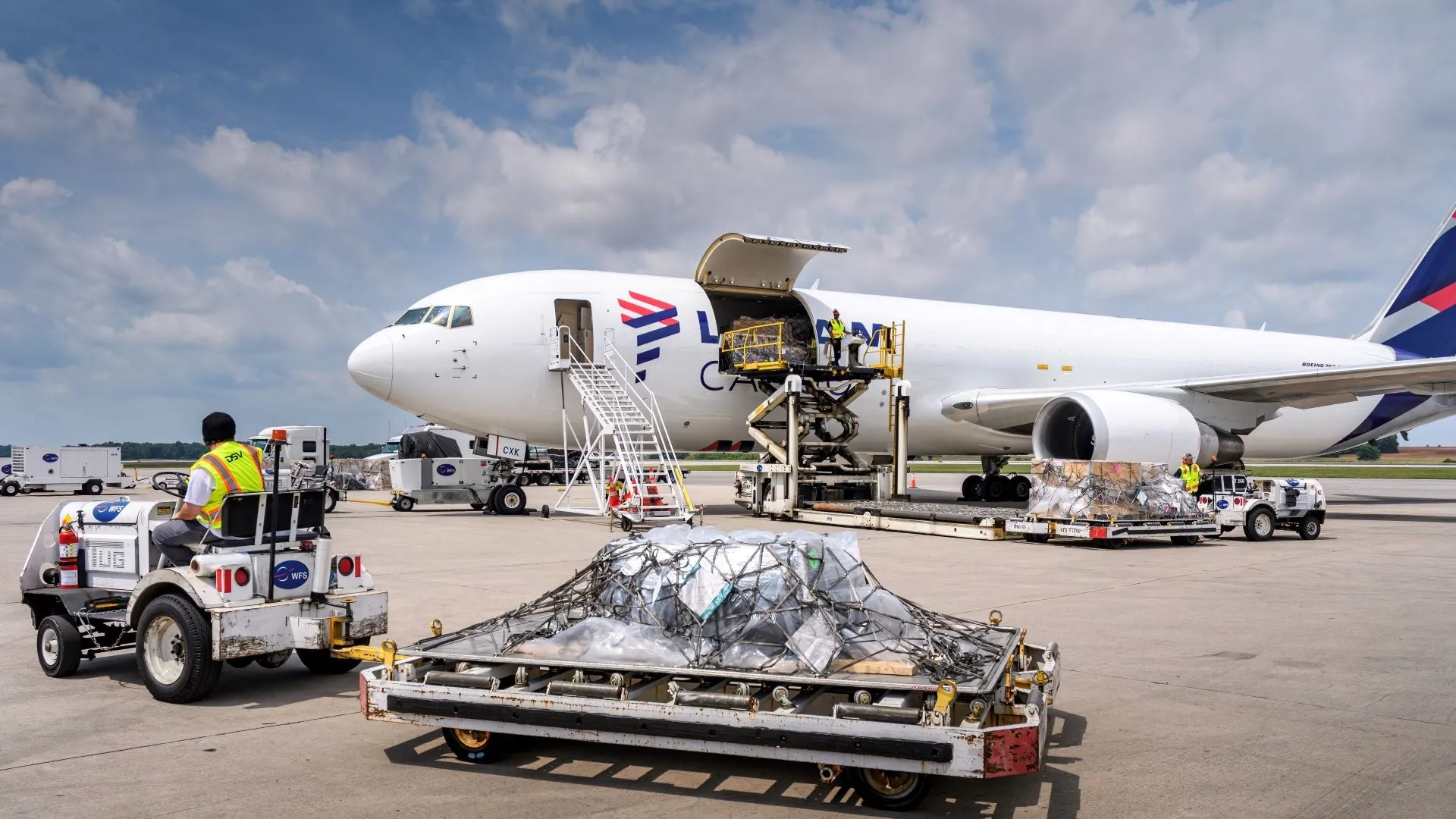
MIA's Foreign Trade Zone Magnet Site designation (FTZ #281) lets on-airport tenants defer or eliminate customs duties on imports staged inside the zone, with streamlined CBP processing and the ability to mix foreign and domestic merchandise. Common FTZ operator industries at MIA include electronics, e-commerce, luxury goods, precious metals, pharmaceuticals, aerospace, and auto parts. The MIA Future Ready capital improvement program is rebuilding cargo infrastructure across the apron; in 2025, a new dedicated Perishables Facility broke ground — purpose-built for the airport's largest single cargo category.
Cargo
What moves through the apron.
MIA's cargo composition is unlike any other major U.S. airport. Imports are dominated by Latin American perishables; exports skew toward high-value manufactured goods bound for Caribbean basin and Latin American consumer markets. The 2024 commodity rankings (the most recent full year reported by MIA) tell the story plainly:
- Cut flowers, live trees, plants & bulbs
- Fish, crustaceans & aquatic invertebrates
- Edible vegetables & certain roots & tubers
- Edible fruit & nuts; citrus fruit; melon peel
- Electronic devices
- Industrial machinery, tools & parts
- Electronic devices
- Plastics
- Pharmaceuticals
- Articles of iron or steel
Top imports by volume
Top exports by volume
On the import side, four of the top five commodities by volume are perishables — cut flowers from Colombia and Ecuador, fish and seafood from Chile and the Caribbean, fresh produce from across Central America, fruit and citrus from the same trade lanes. The fifth, electronics, includes high-value time-sensitive freight that the seaports don't compete for.
On the export side, pharmaceuticals appear in the top five — a direct result of MIA's IATA Pharma Hub status. The remaining export categories (industrial machinery, electronics, plastics, iron and steel articles) tend to flow toward Caribbean basin manufacturing centers and Latin American consumer markets, often on the same freighters that arrived loaded with perishables.
Industries
Who's flying it.
The shipper base at MIA reflects the commodity mix. Industries that move significant freight through the airport include:
- Perishables — flowers, seafood, produce. MIA is the dominant U.S. air entry point for Colombian and Ecuadorian cut flowers, Chilean salmon, Central American fresh produce. Cold chain integrity, customs preclearance, and same-day onward distribution are operational baselines, not specialty workflows.
- Pharmaceutical cold chain. MIA was designated in 2015 as the first IATA-certified Pharma Hub Airport in the U.S. (second globally) under the CEIV Pharma program. Eleven members of the MIA cargo community hold CEIV certification — six airlines (LATAM Cargo first in the Americas), two international freight forwarders, and three ground handling companies. Pharma shipments through MIA flow on certified carrier-handler-forwarder triads from origin to U.S. inland distribution.
- E-commerce and high-value time-sensitive. Inbound electronics, premium consumer goods, and goods routed to FTZ-tenant operations on the airport apron. Often integrated with PortMiami container operations when freight volumes permit mode-splits.
- Luxury goods and precious metals. Gold, pearls, gemstones, and precious metals — top imports by trade value. MIA is one of the largest U.S. ports of entry for high-value declared cargo.
- Aerospace and defense components. Aircraft parts, spacecraft components, avionics — both for the active South Florida aerospace ecosystem and as transshipment cargo toward Latin American carriers.
- Industrial machinery and high-tech. Exports heavily, imports selectively — the equipment flows that fuel Caribbean basin manufacturing and Latin American industrial development.
Our posture
How we operate at MIA.
MIA is forty minutes south of Pompano Beach, the same distance as PortMiami. The operational similarity ends there. Air freight runs on different cycles, different handler chains, and a different customs posture than ocean freight. Working MIA well requires its own discipline.
We don't run a cargo handling facility on the airport. What we do is sit close enough to the cargo apron to know which of MIA's eleven CEIV-certified pharma-hub members handles a given lane, which freight forwarder has the cleanest customs entry record for a given commodity, and which carrier offers the best window for a time-sensitive shipment to clear and move north. For perishables — MIA's largest single category — we coordinate with cold-chain certified handlers on the apron and the temperature-controlled drayage operators on the trucking side.
For freight clearing MIA: drayage from the cargo apron to our Pompano Beach warehouse (often inside ninety minutes door-to-door including customs clearance for routine entries), transload onto LTL or FTL for onward distribution, customs entry coordination with the appropriate licensed broker, and Foreign Trade Zone routing through FTZ #281 where the cargo workflow benefits. For freight bound the other direction — exports through MIA — we handle freight forwarding, customs preparation, and the handoff to the carrier or ground handling agent on the air-side.
Bilingual (English / Spanish) trade documentation is standard; most LATAM freight forwarding moves on Spanish-language paperwork at one stage or another. Our author and operations lead, Isabella Reyes, has thirteen years' experience working this specific corridor — see the Journal for her field reports on the MIA cargo apron.
Next
If your freight has to clear MIA.
Tell us the lane, the freight, and the cold-chain or pharma requirements — we'll route the inquiry to the handler-carrier- forwarder triad that fits the workload. Somebody picks up the phone within thirty minutes during business windows.